Merlin’s weekly podcast with Dan Benjamin. We talk about creativity, independence, and making things you love.
The High Cost of PretendingMerlin Mann | Dec 9 2008
apophenia: Warning: Email Sabbatical is Imminent .. and other random thoughts [via trivium] danah boyd is finishing her dissertation, then going on vacation for a month. While, she's gone, she's not accepting email. At all. Got that? No apology. No "vacation message" to pretend she'll read it later. And no implied promise that the stuff people send to her will magically be tended to by an invisble army of interns and elves. While she's away, every message she receives is simply discarded with a friendly response as to why. danah writes:
If you roll your eyes at such fancy, uppity, big-city behavior, consider the alternatives most of us suffer in order to pretend we're listening. Even when we know we're not. read more »POSTED IN:
Gmail Outage or: How I Learned to Stop Worrying and Love GTD ContextsMerlin Mann | Aug 12 2008
Like thousands of people yesterday, I was annoyed and inconvenienced by Gmail's unexpected 2-hour dirtnap. But, wow. Apparently, it just irrevocably hijacked the whole day for some folks. And even sent a few into a Dark Afternoon of the Soul that most 19th-century Romantic poets would have found a bit histrionic. Now, as a user, polemicist, and nemesis of Apple's MobileMe problems, I'm not here to criticize the frustration about a broken cloud service; I know that feeling all too well and have the dents in my wall to prove it. But, I do want to talk about some strategies you can choose to employ whenever a change in access to anything unexpectedly rearranges your day. Because things do break, and there's no reason you have to break with them. read more »POSTED IN:
Making Time to Make: One Clear LineMerlin Mann | Aug 6 2008
This article is Part 3 of a 3-part series about attention management for people who do creative work called, Making Time to Make.
The point, from my perspective, is that Stephenson possesses the man-sized pant stones to declare precisely what the people who enjoy his work should expect from him. And, in so doing, he has drawn a clear line that some might find hard to love, but that is very easy to see, understand, and respect. No, he didn’t hire someone to answer his email, or get a kid to pretend to be him on Twitter, or install a Greasemonkey script that “autopokes” people on Facebook (I’ll leave you to guess which two of these I do). Neal Stephenson essentially said, “Listen, gang, here’s what I’m going to make for you: novels.” And then, he went back to typing. To working. On work. read more »POSTED IN:
Making Time to Make: The Job You Think You HaveMerlin Mann | Aug 5 2008This article is Part 2 of a 3-part series about attention management for people who do creative work called, Making Time to Make.
POSTED IN:
Making Time to Make: Bad CorrespondenceMerlin Mann | Aug 5 2008This article is Part 1 of a 3-part series about attention management for people who do creative work called, Making Time to Make. Over the years, novelist Neal Stephenson (wiki), has had at least a couple different pages where he's explained why he's chosen to limit the access he provides via email, interviews, and phone calls. It appears to be something he's given a lot of thought to. Via Jessamyn, here's an Archive.org mirror of an older version of his page where he explains his introversion and need to stay focused on his work, alongside FAQs that answer many of the questions he typically has to field. Read it all though. It's pretty good. Stephenson's bottom line?
And here's another well known piece, Stephenson's "Why I am a Bad Correspondent", in which he lays out more details about why he's chosen to create an expectation based on guarding his attention so slavishly: read more »POSTED IN:
On Peanut Shells and Email ArchivingMerlin Mann | Jul 24 2008
Real Estate Connect San Francisco 2008 | Inman News Later this morning, I'm honored to be delivering the keynote address at the Inman Real Estate Connect conference here in San Francisco -- coincidentally, a conference I attended in 2000 as the "Senior Producer" (whatever that means) for the real estate dotcom I was working for. I'll be doing my Inbox Zero talk and touching on some of the ways that real estate agents can use the system in their go-go, always-on sales environment. There are several new slides in today's deck that I'll be premiering with this version of the talk -- the one above reflects something I've been returning to a lot lately in helping people to spend less time fiddling with their messages: stop obsessing about "organizing" your email. read more »POSTED IN:
NYT: Businesses Fight the Email Monster They Helped CreateMerlin Mann | Jun 14 2008Lost in E-Mail, Tech Firms Face Self-Made Beast - NYTimes.com Is Information Overload a Billion Drag on the Economy? - Bits - Technology - New York Times Blog
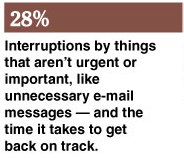
If you've seen the video of my Inbox Zero talk at Google, you may recall the moment when a few attendees start mentioning the hundreds of internal email messages they receive (and send) in a given day. I still remember, because I almost fainted. Whenever I hear these and similar stories, the same question always comes to mind: "What does a company get out of its employees spending half their day using an email program?" Well, apparently, it's a question a lot of people are starting to ask. Including Google. read more »10 Comments
POSTED IN:
Email Insanity & the 0.001 ChallengeMerlin Mann | Apr 24 2008
Via a Toot by Jeff Atwood comes this thoughtful post by Tantek Çelik on how email is no longer working for him. His first reason is a biggie:
This is one reason I'm getting attracted to using Get Satisfaction as a way to expose help issues to a large group of helpers and helpees (BTW, we're just getting started on GS -- FAQs and more will be coming soon). I'm also realizing that this is why I (and Jonathan Coulton and probably you) struggle with holding up dozens of one-on-one conversations -- it locks up your attention and its fruits in thousands of inaccessible alcoves. And truly, that does not and will not scale. But, y'know, as I read Tantek's post, alongside his "Communication Protocols" notes, I found myself returning to a pet theory that I've been too embarrassed to lay out in a real post. But what the heck, I'll capture some notes and you can tell me what you think: I suspect that email encourages people to act insane. read more »POSTED IN:
Vox Pop: Patterns for email as work conversation?Merlin Mann | Mar 12 2008Inbox Zero is a system and philosophy that most benefits people who are overwhelmed by a high-volume of mystery meat email. The system works because it's stupid-simple, and the real art comes out of getting fast and ruthless at identifying requests for your time and attention that must be acknowledged or completed vs. the vast majority of stuff that needs very light attention (or can just get deleted). But, not so fast -- what if, instead, you're receiving a high volume of easily identifiable messages? And what if your main "action" is reading, digesting, and then contributing? That's a bit trickier, as I have learned. Every time I give the Inbox Zero talk to a tech-heavy group -- and most especially when I talk with engineers -- there's pushback on a couple issues. First, a lot of techies say they love it when everything gets routed through email, and second, they think an Inbox-Zero-type methodology isn't particularly useful for the type of communication that they get all day long. And that's conversations. Lots of conversations. For many tech folks, email is the ideal and preferred way to avoid meetings and pointless flights. It's where they discuss features, debate implementation, and argue over the best solution to a problem. And that's how they like it. Some companies I visit with tell me they take pride in generating over 1000 person-messages each day. That's their culture, and love it or leave it. This doesn't mean there's not room for improvement, but of course it's a valid and very real way to work. Do stay tuned after the jump for your chance to join the conversation with comments and tips for managing conversational email, but first here's my observations on a few patterns that seem to work for a high volume of conversation based email: read more »POSTED IN:
Meet SandyMatt Wood | Nov 21 2007
POSTED IN:
|
|






| EXPLORE 43Folders | THE GOOD STUFF |


